





Throughout much of 2024 and 2025, the political centers of Europe have watched the headlines from Berlin with a mix of concern and curiosity. With sick days hitting record highs, it seemed like the continent’s economic engine finally stalled under a 'sickness crisis'. Depending on the source, German workers were reported to take the equivalent of three to four weeks of sick leave per year. For critics, the diagnosis was simple: a generous welfare state was meeting a ‘lazy’ workforce.
However, that interpretation skips two crucial questions: What are these numbers actually measuring, and are they truly exceptional in context?
ifb and the data experts at DataPulse Research analyzed official data to create a harmonized analysis of EU labor data.
Sick Leave Across Europe
To understand sick leave across Europe we must first find data that is comparable across different countries. For this we turned to the Organisation for Economic Co-operation and Development (OECD). Unlike national health insurers (like the AOK or TK in Germany), which rely on official filings such as doctor certificates, the OECD primarily uses Harmonized Labour Force Surveys (LFS). In these surveys, workers are asked directly about their absences. This is the "Gold Standard" for international comparisons because it bypasses the massive differences in how sick leave is recorded by government ministries and insurers across borders.
And this distinction is vital. As of January 2025 (according to a January 2025 report from healthcare research and consulting firm IGES), only Germany, Estonia, Latvia, and Poland have a mandatory electronic reporting system (eAU) in place. In Germany, this system was introduced in January 2022 and automatically transmits certificates from the doctor to the insurer.
Before 2022, millions of German sick days were simply “invisible.” A worker might stay home for two days with a cold, get a paper note, but never bother to mail it to their insurance provider. The "dramatic" jump in German sick days reflects precisely this shift: from behavior to visibility. It is worth reiterating: Germany’s "record" numbers, from 11 days (2021) to 15 days (2022, 2023 and 2024), do not reflect a sudden decline in worker health; they are the result of more accurate counting.
Europe at a Glance: From Norway to Romania
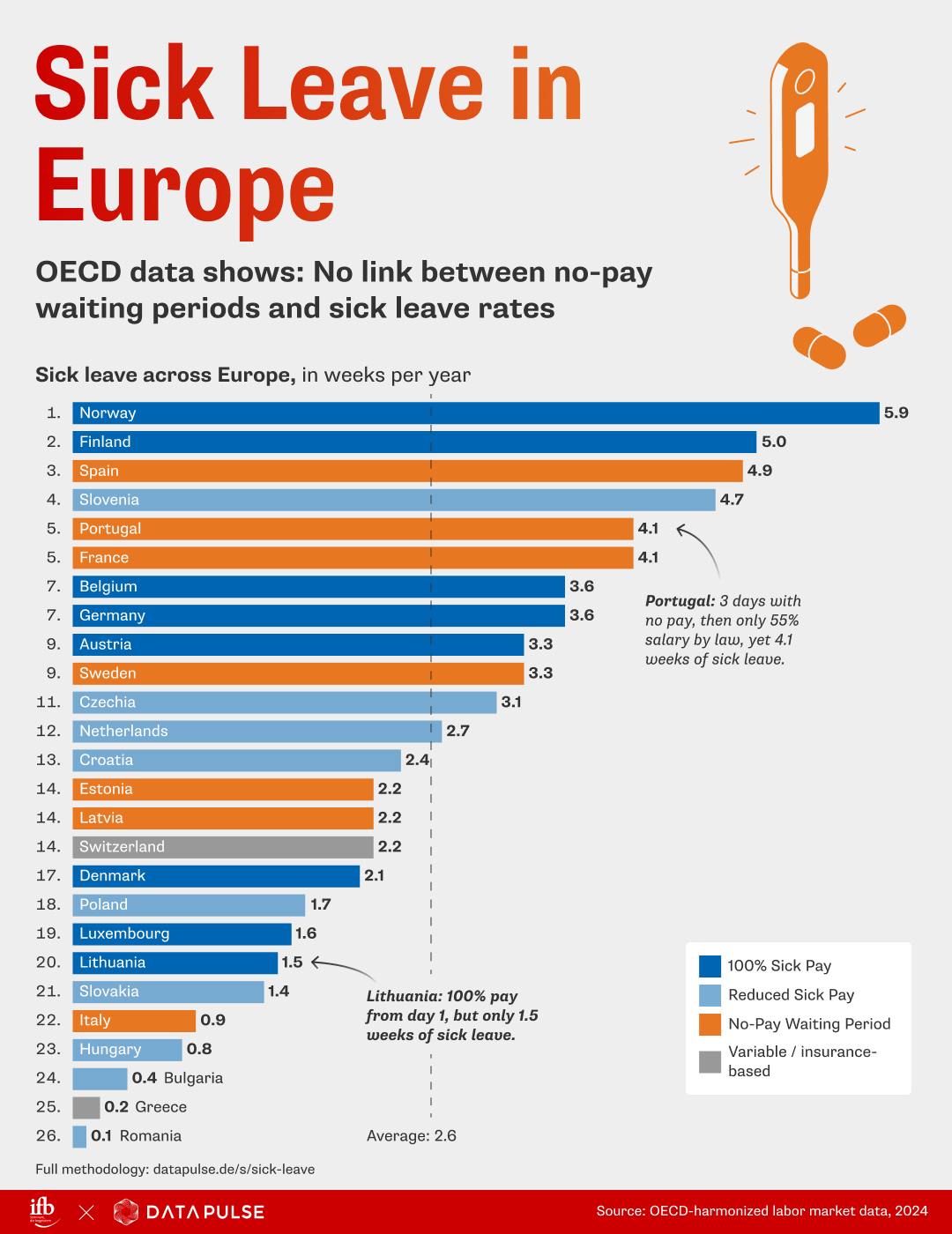
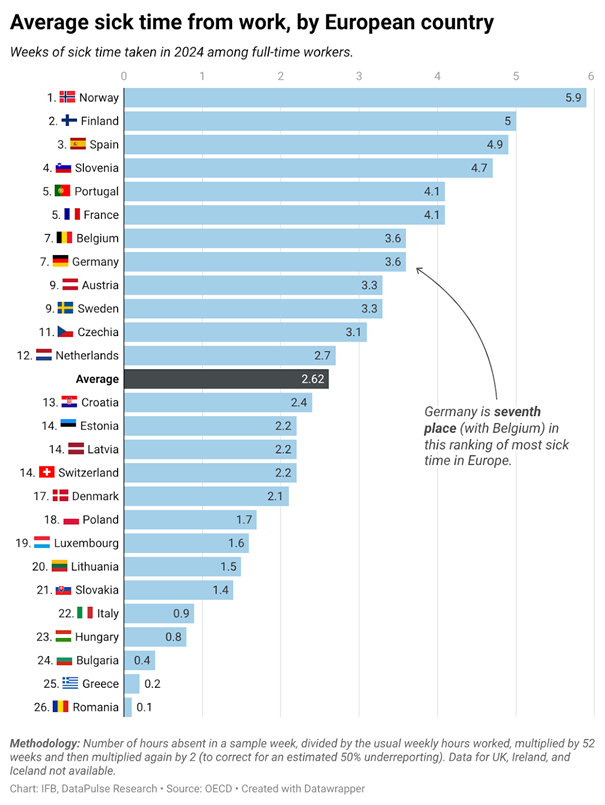
Using OECD data and comparing annual sick leave across the continent, the range is staggering:2
- The High-Record Group: Norway leads the pack with nearly six weeks a year. Finland follows closely with 5.0 weeks, which is approximately 39% higher than Germany's 3.6 weeks.
- The "Middle" Tier: Germany sits at 3.6 weeks, ranking 7th. It is grouped with high-output economies like France, Slovenia, and Belgium (with which Germany is roughly tied).
- The Bottom of the List: Countries like Romania and Greece report almost no sick leave.
- The European Average: Across Europe we see that the average worker takes 2.6 weeks of sick leave per year.
© OECD
Why do some nations appear so healthy on paper? These stark differences are rarely a sign of physical vitality. In regions like Romania or Greece, low absenteeism typically indicates high job insecurity and if you don't show up, you often don't get paid. So even with the OECD’s harmonized adjustments, we must acknowledge that we are comparing fundamentally different national cultures of reporting and social security.
It is often assumed that lenient policies, those protecting wages from day one, inevitably incentivize a workforce to stay home. Put bluntly: a generous safety net breeds a "lazy" workforce. In the next section, we test for this "Policy Correlation" across Europe, to see if financial penalties actually get people back to their desks.
Unpaid Days Don’t Stop the Flu
As the debate over Germany’s economic competitiveness intensifies, a familiar proposal has returned to the political center: the introduction of Karenztage (unpaid waiting days). The idea is that if workers faced a financial penalty for the first one to three days of illness, they would be less likely to "skip work" for mild symptoms. It wouldn’t be an unprecedented policy, as many other countries impose such rules.
However, European data suggests that this policy is an instrument that often fails its objective.
The table below maps countries based on their initial sick-pay rules. The colors indicate the level of financial protection: dark blue for full pay from day one, light blue for reduced wages during the first sick days, and orange for countries with unpaid waiting periods.
What the data indicates is that there is no discernable pattern. Some of the most "generous" systems have the lowest absenteeism, while some of the most "punitive" systems are struggling with high numbers.
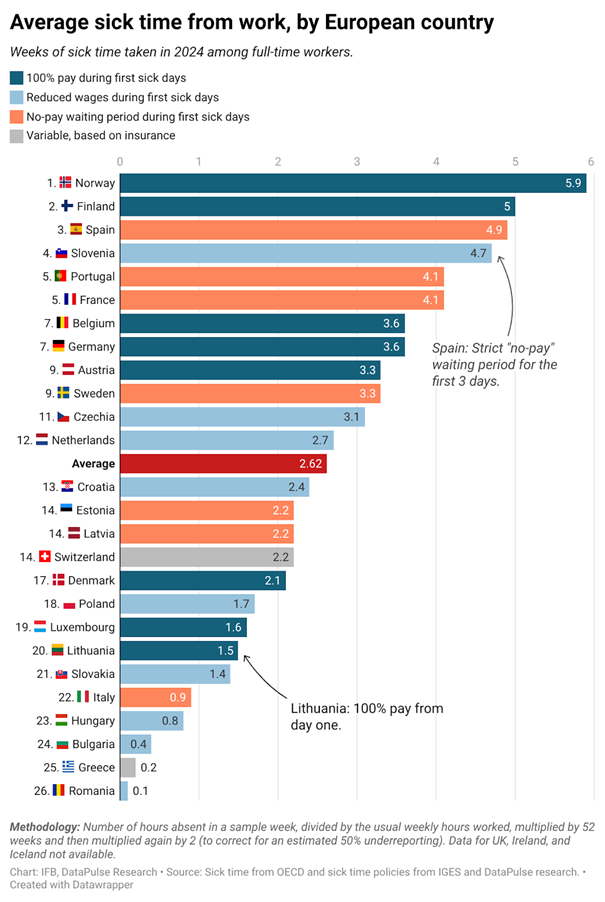
To illustrate this, take the comparison between Spain and Lithuania.
- Spain: Operates a strict system where the first three days of illness are typically unpaid. Under the "deterrence" theory, Spain should have a highly disciplined workforce. Instead, Spain records nearly five weeks of sick leave per year.
- Lithuania: Provides full pay from the very first day of illness. Yet, Lithuania reports just 1.5 weeks of sick leave, some of the lowest in the comparison.
So why do some lenient countries have high absence levels while other lenient countries have low absence rates? It’s hard to say exactly, as there are a few factors at play. In some places, the workforce may indeed feel more at ease to stay home early in an illness; as one 2025 European study noted, the chance that someone works while sick drops by about 8 percentage points when there is generous sick pay.
At the same time, the people who stay home help to keep their co-workers healthy, which could mean that fewer people overall are calling in sick. One study from the United States (where sick leave policies are highly variable from company to company) showed that workers with paid sick leave spent an average of 4.6 days away from work per year due to illness or injury, while those without paid sick leave spent 3.5. The study estimated that if paid sick leave were universally implemented, there would be significant cost savings to businesses and higher productivity amongst workers, because the number of workdays lost to influenza-like illness alone would drop by infection by between 3.7 million days and 10.97 million days per year.
Calling in Sick: The 1%
Parallel to the Karenztage debate is the criticism of Germany’s "Telephone AU", the ability to obtain a sick note via a phone call. Cynics argue that this is an "invitation to blue-line," making it too easy for workers to stay home without a physical examination.
However, data from the Central Institute for Statutory Health Insurance Physicians (Zi), published in October 2025 officially debunked this "easy out" narrative. The analysis of millions of records found:
- Telephone certificates account for only 0.8% to 1.2% of all sick leave certificates annually.
- Video consultations account for even less.
Of course, there is a possibility that the phone-based sick note and video consultation is still relatively underutilized by the general population. Originally a temporary pandemic measure introduced in 2020, it was only made permanent in December 2023 to provide administrative relief for overburdened family doctors. Combined, however, these digital shortcuts represent barely 1% of the total volume of sick leave, making the telephone AU a statistical red herring. Abolishing it would likely do nothing to lower the national average, but it would significantly increase the administrative burden on doctors and the risk of infection in waiting rooms.
The Real Drivers - From Flu Waves to Mental Health
If policies and "convenient" phone calls aren't driving the numbers, what is? There are no easy answers, especially when looking at the diverse landscape of Europe. Each nation grapples with a unique cocktail of workplace cultures, demographic shifts, and varying social stigmas.
For Germany, however, the "sickness crisis" becomes much clearer when we stop looking at the total volume and start looking at the diagnoses. According to the Wissenschaftliches Institut der AOK (WIdO) July 2025 report, the most traditional illnesses, including injuries, cardiovascular problems, and digestive issues, sick days have stayed remarkably stable for over a decade. Based on this analysis by AOK, the German absenteeism figures are not a broad decline in worker health, but are instead shaped by three very specific, high-impact factors:
1. The Post-Pandemic Respiratory Baseline
Since COVID-19, public awareness of viral transmission has shifted. The severity of respiratory illnesses fluctuates from year to year, but the number of respiratory-related sick days has remained at a significantly higher baseline since 2021. What was once "working through a cold" has shifted toward recovery and prevention of office-wide outbreaks.
2. Mental Health
One of the most significant long-term drivers is mental health. According to AOK, one in eight sick days (12.5%) in 2024 were attributed to mental health diagnoses, making it the third-largest category after musculoskeletal (19.8%) and respiratory issues (15.1%). And there’s a clear upward trend: Sick days linked to mental health conditions have risen 47% since 2014, according to AOK, and the number of cases (workers processed by insurance) is up nearly 30%.
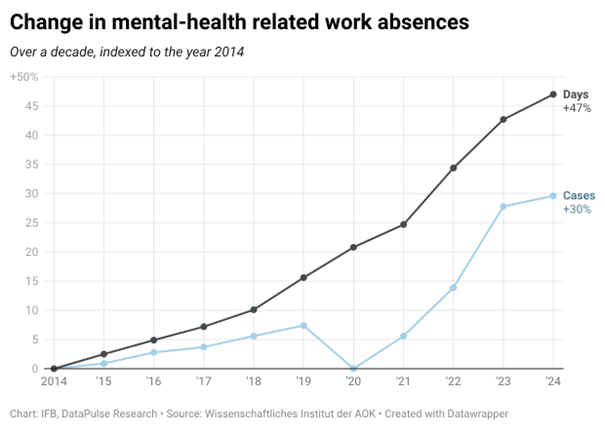
Other insurers have picked up on the trend as well. TK, another German insurer, noted in its analysis that there has been an uptick in mental-health related sick days over the last few years. For 2025, absences due to mental health conditions averaged 3.81 days, up from 3.75 in 2024, up from 3.59 in 2023, and up from 3.33 in 2022.
3. Long-Term Illness: Few Cases, Many Sick Days
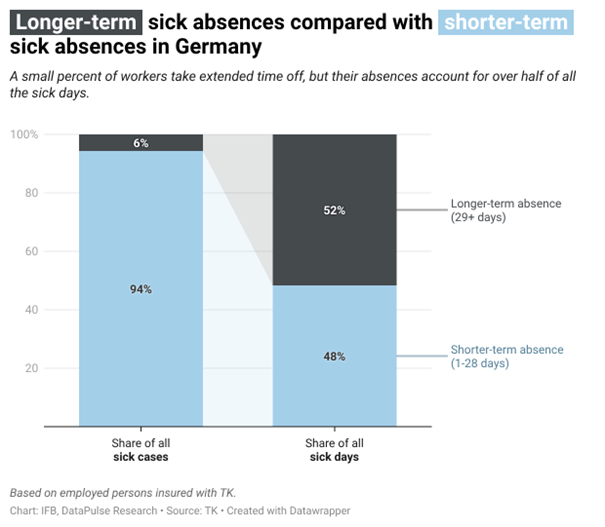
For one thing, sick leave tends to be very temporary. According to the insurer TK, close to 40% of sick cases (employees) in 2025 lasted just one-to-three days. Another third of the cases were for four-to-seven days. The remaining third were people who needed more than eight days. While very long-term sick leave is rare, it accounts for a great share of Germany’s total sick days. Less than 6% of the working population takes 29 or more days, but their absences account for just over half of the country’s sick time.
Output Over Attendance
In Germany, the financial burden of these absences is split. For the first six weeks, employers must pay 100% of a worker’s salary; only after that does the health insurance take over. For small businesses with fewer than 30 employees, a mandatory insurance scheme helps reimburse a portion of these initial costs.
To understand the true economic impact, however, we have to look beyond who pays for a sick note and ask what happens to the work itself.
The arithmetic logic is undeniable: every sick note reduces the theoretical time available for value creation. But to assess whether Germany is truly an outlier, we need to shift perspective from individual sick notes to overall workforce availability.
Actual Workforce Availability Across Europe
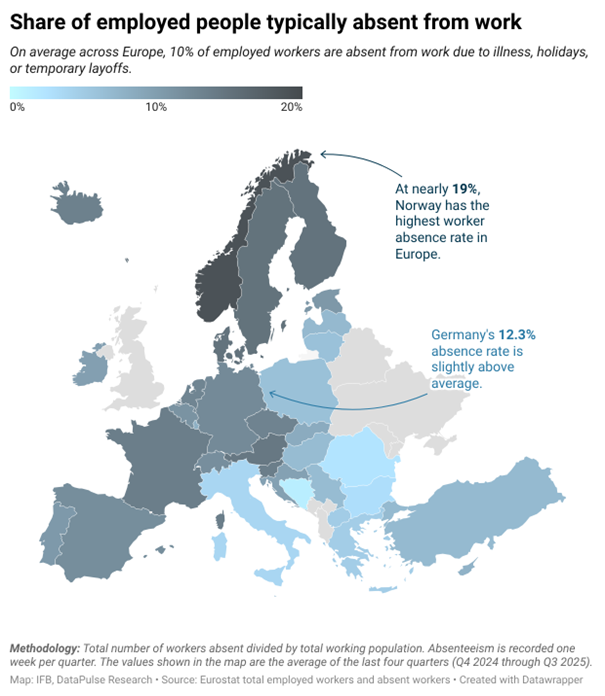
Sick leave is only one piece of the puzzle; workers can be absent for many reasons, from vacation and parental leave to public holidays. The point is not how people spend their time off (whether recovering from a severe flu or faking one to go on vacation), but the actual availability of the workforce.
Germany’s overall absence rate is just above the continental average. With 12% of its workforce absent at any given time, Germany manages a very typical worker-to-non-worker ratio. While Norway sees nearly 19% of its workforce absent at any given time (the highest in Europe) and Italy has less than 4% of its workforce absent.
Why Output Isn't Tied to the Time-Clock
Despite this rather typical absence rate, a recent study claims that high sick leave caused the German economy to shrink by 0.5%, a loss of roughly €26 billion.
This figure has become political ammunition, fueling the ‘lazy worker’ narrative. But does a sick day truly equal a direct, linear drop in GDP? High absence rates undoubtedly cause real costs and organizational overhead for businesses. Yet the assumption that every missing hour reduces competitiveness one-to-one falls short.
When we compare GDP per hour worked against sick time across Europe (adjusted for purchasing power), the following picture emerges:
- The High-Performance Absentees: Norway and Belgium take significantly more days off than the European average, yet they maintain some of the highest productivity rates in the world. Norway, despite having the most sick time in Europe, ranks second only to Luxembourg in GDP per hour.
- Conversely, countries like Greece and Hungary have less than one week of sick time per employee, yet they sit at the bottom of the productivity rankings.
- Germany is moderately above average in terms of sick time and hourly productivity, ranking seventh place in both categories.
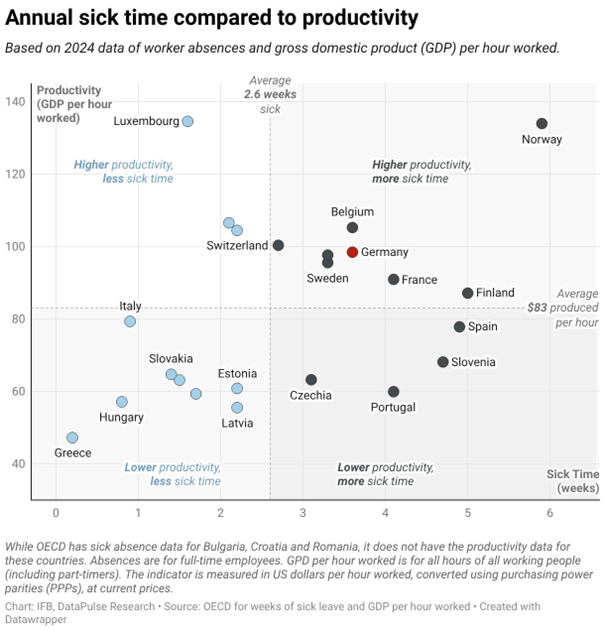
Productivity is a complex metric, often influenced by a nation’s economic history, industrial density, and technological infrastructure. However, if we only obsess over the 20 days Germans spend out of the office while ignoring the 200 days they spend in the office, we miss the factors that truly drive a modern economy: work intensity, technological leverage, and mental focus.
The key question is: Can you have high sick leave and high productivity at the same time? The data suggests: yes.
Presenteeism, the act of working while unwell, might be an important reason for this. It leads to critical mistakes, longer recovery times, and office-wide outbreaks that degrade the quality of work.
Conclusion
Germany’s sick-leave numbers may look alarming at first glance, but a data-driven assessment puts this picture into perspective. Germany is by no means the lone “sick man” of Europe, but rather a country grappling with the same post-pandemic shifts as its neighbors, above all the massive rise in mental health conditions.
The key difference lies not in work ethic, but in measurement. The hunt for the “missing German worker” ends not in a doctor’s office or on a malingerer’s couch, but in the data centers of health insurers. Through the digitization of its reporting system (eAU), Germany has begun counting the truth without gaps. Treating sick days primarily as a question of incentives ignores the complexity of the data at hand. This comparative European analysis provides no statistical evidence that financial penalties or unpaid waiting days sustainably reduce absenteeism.
Equally, the debate around telephone-based sick notes, at roughly 1% of total volume, proves to be a statistical sideshow whose abolition would promise barely measurable effects on the national sick rate. Ultimately, the international comparison shows that high hourly productivity and above-average absenteeism can coexist. A modern economy can remain highly productive when it acknowledges health-related absences rather than statistically concealing them through presenteeism pressure.
Methodology
Regulations vary significantly from country to country. The early-sickness policies in the bar chart are adapted from a January 2025 report from healthcare research and consulting firm IGES, which outlines each country’s independent rules for compensation during early illness, rules about extended illness, and definitions about what time period constitutes short versus long illness.
To calculate the percent of all absent workers (for the map), we took the number of workers absent divided by total working population. Both absent worker and total worker datasets are from Eurostat, where absenteeism is recorded one week per quarter. The values shown in the map are the average of the last four quarters (Q4 2024 through Q3 2025). The total number of workers includes people aged 20 to 64 who worked at least one hour for pay during the reference week or were temporarily absent from such work. Absences include holidays, illness, and temporary layoffs.
Sources
- OECD Health Statistics: "Absence from work due to illness," OECD Data Explorer, as of February 2026. Available at: https://data-explorer.oecd.org (Filter applied for time series from 2010 onwards).
- IGES Report: Report by the health research and consulting firm IGES, January 2025.
- Sick Leave Report (Fehlzeiten-Report) 2025: Published by the Scientific Institute of the AOK (WIdO).
- vfa (Association of Research-Based Pharmaceutical Companies): Analysis of the economic impact of sick leave on GDP.